
THE SHAPE THAT HATES YOU
One of these four archetypes attacks a five-pip, zero-generic, repeatable activation more directly than it attacks anything else in the format. Name it before you look at the meters.
This is the one. Five coloured pips with zero generic, activated repeatedly, is the most tax-exposed engine shape in Commander — there is no generic component to pay around, so anything raising the cost of turning mana into effects, or keeping lands tapped, hits you harder than it hits a ramp deck. You are the beatdown here and the role is forced: race the lock's completion, because you do not own the long game underneath one. Recount your activations under the tax rather than your cards, and recount honestly — three of your own accelerants cannot pay a single pip.
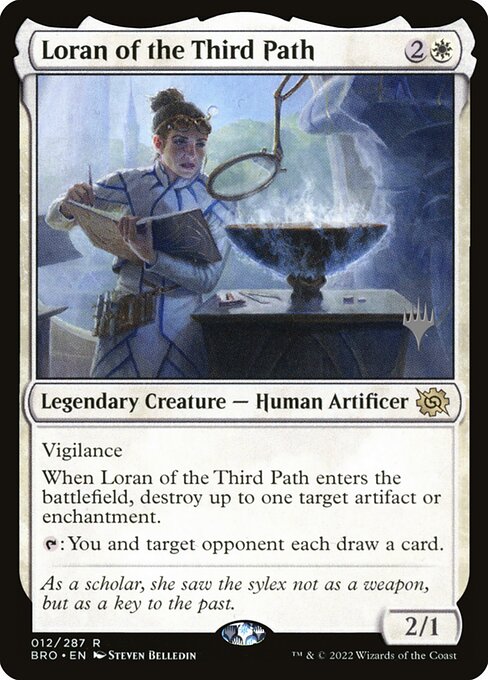
Your outs: Loran of the Third Path, Teferi, Time Raveler, Plaza of Heroes, Path to Exile
Your posture inverts completely: hold the pips for interaction and count the table's open mana instead of advancing the ladder, because a ladder is worth nothing if the game ends before it matures. The structural problem is that your interaction is exactly the part Sisay cannot reach — all six counterspells, both free protection instants, Grand Abolisher and Drannith Magistrate are non-legendary. Two fetchable pieces do real work and you should reach for them before you reach for a finisher.
Your outs: Teferi, Time Raveler, Kutzil, Malamet Exemplar, Silence, Path to Exile, Grand Abolisher
Assume the wrath — across four players one is near-certain — and price it double, because it takes the board and drops the ladder from 28 targets back to three, with no legendary lands to give you a mana-value-0 floor. The Sisay-specific reading of 'commit only as much as wins' is about where the colour lives, not how much you show: keep a two-colour legend in hand, because a hand copy restores two rungs and a board copy dies with everything else. Your indestructible instants beat destruction and do nothing against exile or −X/−X.
Your outs: Heroic Intervention, Flawless Maneuver, Boros Charm, Toxic Deluge, Katilda, Dawnhart Prime
Roughly 120 life behind three defences means you never race, and you are not being asked to — your answers here are virtual rather than spent. One fetch blanks plans from three seats at once, which is the only economical way to answer aggression in a four-player game, and every piece that does it is a legendary permanent at mana value 2 to 4 sitting inside the pool from two colours onward. If you get pulled into a two-player race, treat it as a subgame, spend the minimum that wins it, and keep watching the other seats.
Your outs: Thalia, Heretic Cathar, Sheoldred, the Apocalypse, Shalai, Voice of Plenty, Flowering of the White Tree
Sweeper control. Assume the wrath — across four players one is near-certain — and price it correctly, because here it costs double: it takes the board and collapses the ladder from power 5 or 6 back to power 2, where exactly three cards in the deck are legal fetches and there are no legendary lands to give you a mana-value-0 floor. The Sisay-specific reading of 'commit only as much as wins before it arrives' is therefore about where the colour lives, not how much of it you show: keep a two-colour legend in HAND — Katilda, Kutzil, Kinnan, Lotho, Kambal, Saffi — because a hand copy restores two rungs after the wipe while a board copy dies with everything else. Your instants are asymmetric in a way that matters: Flawless Maneuver, Heroic Intervention and Boros Charm's 'Permanents you control gain indestructible until end of turn' beat destruction-based wraths and do nothing against exile or against Toxic Deluge's -X/-X — and your own Toxic Deluge is the copy whose timing you choose, which makes you the deck that recovers cheapest from a wipe it picked. The goldfish says the insurance is genuinely there: protection available in 88.4% of games, 79.8% by turn six, mean turn 2.3. Rebuild worst-first, and remember each trip through the command zone adds {2}.
Stax and tax. You are the beatdown and the role is forced — race the lock's completion, because you rarely own the long game underneath one. Five coloured pips with zero generic, activated repeatedly, is the most tax-exposed engine shape in the format: there is no generic component to pay around, so anything that raises the cost of converting mana into effects, or that keeps lands tapped, hits you harder than it hits a generic ramp deck. Recount your activations under the tax rather than your cards, and recount honestly, because three of your own accelerants cannot pay the activation at all — Delighted Halfling makes mana only for legendary SPELLS and an activated ability is not a spell, Unclaimed Territory is creature-spells-only, and Sol Ring makes colourless against five coloured pips. Plaza of Heroes carries the same trap and its own escape: the legendary-spell ability is dead for this purpose, the 'add one mana of any color among legendary permanents you control' ability pays the cost fine. Your fetchable out is Loran of the Third Path — mana value 3, live from two colours, 'When Loran enters, destroy up to one target artifact or enchantment' — with Teferi's minus-three bounce as backup. Name the piece that breaks the lock on YOU, not the scariest piece on the table.
Aggro. Roughly 120 life behind three defences means you do not race, and you are not being asked to — your answers here are virtual rather than spent. Thalia, Heretic Cathar makes their creatures and nonbasic lands enter tapped; Sheoldred turns every opponent's draw into 2 life; Shalai hands you and your other creatures hexproof, which switches off targeted burn and drain outright; Flowering of the White Tree turns a board of 1/1 and 2/1 legends into +2/+1 blockers with ward {1}. All four are legendary permanents at mana value 2 to 4, which means all four are inside the fetch pool from two colours onward — one activation blanks plans from three seats at once, and that is the only economical way to answer aggression in a four-player game. If you get pulled into a two-player race, treat it as a subgame, spend the minimum that wins it, and keep watching the other seats.
Combo. Your whole posture inverts: hold the pips for interaction and count the table's open mana instead of advancing the ladder, because the ladder is worth nothing if the game ends before it matures, and held answers rot — the last profitable moment for your single Path to Exile is when the piece hits the battlefield, not later. The structural problem is that your interaction is precisely the part Sisay cannot reach: all six counterspells, Fierce Guardianship, Flawless Maneuver, Drannith Magistrate and Grand Abolisher are non-legendary, part of the 26 cards in this list that are permanently outside her range. Two fetchable pieces do real work, though, and you should reach for them before you reach for a finisher: Teferi, Time Raveler at mana value 3 ('Each opponent can cast spells only any time they could cast a sorcery') deletes instant-speed combo and instant-speed interaction in the same breath, and Kutzil, Malamet Exemplar turns off opponents' spells entirely during your turn. Those are the closest thing this deck has to tutorable disruption.
Fair value midrange, and the other engine deck. This is where you are cleanly the control seat. Picture turn fifteen with everyone on their best draws — you like that picture, which means the inevitability is yours and you should not force early action. The toolbox out-scales a fair board and the tax shell raises their conversion cost, so manage the pod toward the game length you win: spend a turn or two looking boring after every visible fetch, sequence Najeela and Jodah last, and cash the deflection budget on the turn you take the window rather than the turn a fetch impresses somebody.
Graveyard hate. Mostly a blank against you, and that is worth real money at a four-player table. The deck has no recursion plan beyond Saffi Eriksdotter's sacrifice trigger, so a Bojuka Bog or a Leyline of the Void pointed at your yard is a wasted card, and any hate spent on you instead of on the reanimator seat is a gift. Do not plan around your own graveyard interaction either: Dauthi Voidwalker's void counters are the only piece, and like every other non-legendary card here, it has to be drawn.
You do not run removal. You fetch reasons your opponents cannot use theirs.