
THE ONE CARD THAT FINDS THE OTHER THIRTY-THREE
Your commander is the only card the format guarantees you — and in this deck she is also the only card that reaches the rest of the deck. So what does Commander charge you for that, and what does it quietly hand you for free?

| Cast | Printed cost | Commander tax | Total mana |
|---|---|---|---|
| 1st cast | {2}{W} | +{0} | 3 |
| 2nd cast | {2}{W} | +{2} | 5 |
| 3rd cast | {2}{W} | +{4} | 7 |
| 4th cast | {2}{W} | +{6} | 9 |
- Commander
- Sisay, Weatherlight Captain
- Mana cost
- {2}{W}
- Color identity
- BGRUW
- Type
- Legendary Creature — Human Soldier
- Mean cast turn
- 2.963
- Out by turn 6
- 99%
Start with the rule that makes this a different game. CR 903.6: "At the start of the game, each player puts their commander from their deck face up into the command zone." Sisay, Weatherlight Captain is not a card you hope to draw — she is face up on the table before anybody has looked at seven cards, and in a deck built on thirty-three one-of legendary permanents that guarantee is the whole architecture. Singleton is why: CR 903.5b requires every nonbasic card in the 99 to have a different English name, so consistency in this format normally comes from redundancy of effect rather than copies of a card. This deck buys consistency a different way. It runs one repeatable battlefield tutor and treats thirty-three singletons as a sideboard it can reach into, and the tutor is the one card the format promises you every single game. That is why Keep or Ship, four departments from now, asks your opening hand for colours and fuel and never once asks it for a payoff.
Now the bill, and read the ladder beside this file while you do. CR 903.8: a commander cast from the command zone "costs an additional {2} for each previous time the player casting it has cast it from the command zone that game." Sisay is {2}{W}, so the schedule is three mana, then five, then seven, then nine. Put those against the simulation's own numbers: 4.06 mean available mana on turn four, 5.87 on turn six, 8.27 on turn ten. The first cast is trivially on curve — the model has her down by turn three in 8,028 of 10,000 games. The second cast is a five-mana turn that leaves you roughly one mana, which in this deck means a turn with no activation in it. The third is the entire turn and most of the next one.
Here is the distinction good pilots make and bad ones don't. Spot removal aimed at Sisay costs you the tax and the tempo — it does not cost you the ladder, because her power comes from colours among your other legendary permanents and those are still standing when she comes back. A sweeper is the expensive one: it takes the rungs, and Sisay returns to a battlefield where her gate reads "mana value less than 2" and three cards in the deck qualify. Price those two threats differently. Against a pod that answers creatures one at a time, pay the tax and rebuild. Against a pod holding a wrath, keep a two-colour legend in hand rather than on the battlefield, because the hand copy restores two rungs after the wipe and the board copy dies with everything else.
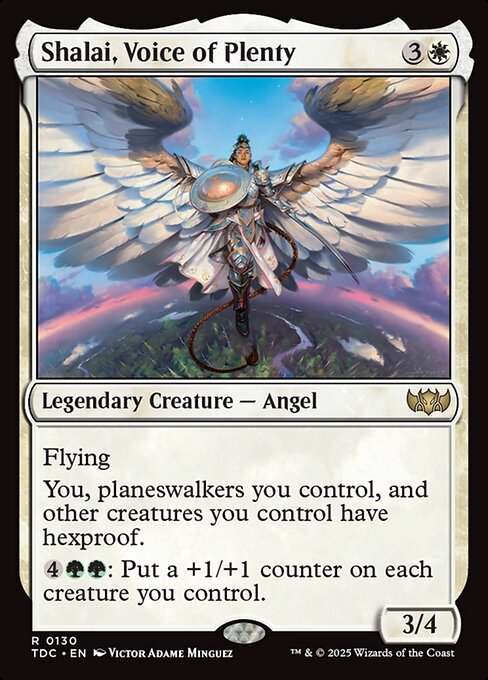
So: protection or speed? The strategy companion is honest about the trade — protection slots and held mana cost you every game, while removal only costs you some — and Cullen's taxonomy splits the options into constant protection, single-use instants, and flexible modal slots. This deck's version of that argument has an unusual shape, because most of its insurance is unfetchable. The simulation has protection available in 88.4% of games and 79.8% by turn six, at a mean of turn 2.3 — but Fierce Guardianship, Flawless Maneuver, Heroic Intervention, Grand Abolisher, Silence and all six counterspells are non-legendary, which means Sisay cannot go and get a single one of them. Exactly four insurance pieces sit inside her range: Shalai, Voice of Plenty, Flowering of the White Tree, Dihada, Binder of Wills, and Plaza of Heroes in the mana base. Our rule: fetch Shalai on the activation before you need her, because she gives hexproof to you and to every other creature you control and cannot protect herself.
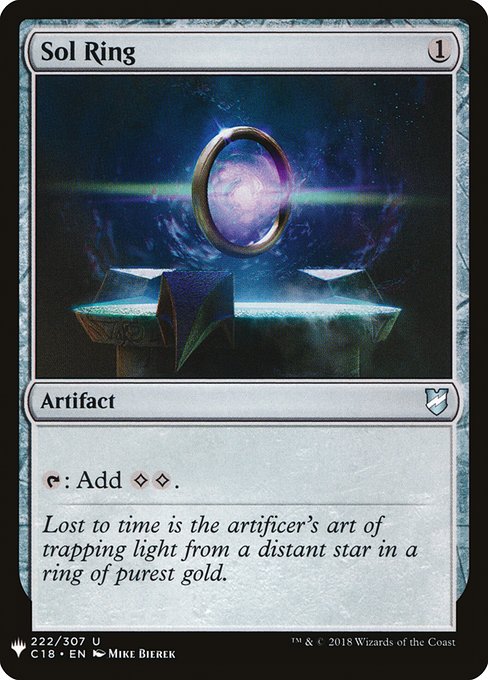
Color identity, and the joke this deck is built on. CR 903.4 defines color identity as "the color or colors of any mana symbols in that card's mana cost or rules text," and Sisay's rules text carries {W}{U}{B}{R}{G}. Her identity is therefore all five colours and the 99 is unrestricted — nothing in Magic is locked out of this deck. Then the same five symbols that opened the door become the door's price: her activation is five coloured pips with zero generic, paid over and over. Color identity gives you every card in the format and the activation cost takes most of your mana base back. That is why three of this deck's own accelerants cannot pay her at all — Sol Ring makes {C}{C} against a cost with no generic component, Delighted Halfling's coloured mana is restricted to legendary spells and an activated ability is not a spell, and Unclaimed Territory is creature-spells-only. It is also why Command Tower here is genuinely any colour, and why Plaza of Heroes' third mode, "add one mana of any color among legendary permanents you control," is one of the best lines of text in the deck.
Is the 21-damage clock real? CR 903.10a: "A player who's been dealt 21 or more combat damage by the same commander over the course of the game loses the game." Sisay at three colours is a 5/5, which is five connections; at four colours she is a 6/6, which is four. That is a shorter clock than you would guess and it is still not a plan — you need her untapped to activate, and her ability has no tap symbol precisely so you can do both, which is a bigger deal than the damage. Track the number on one opponent as a tiebreaker, and note the one card that turns her connections into value on purpose: Kutzil, Malamet Exemplar draws you a card whenever a creature with power greater than its base power connects, and a pumped Sisay is always that creature.
The political read is the gentlest thing about this deck and the most useful. A freshly cast Sisay is harmless and experienced players know it — a 2/2 with a gate of "mana value less than 2" is not worth a removal spell. Your grace period ends at the third colour, not at the commander. Sequence the colours onto bodies that read fair, hold the five pips until you intend to spend them, and remember the asymmetry almost nobody else at the table has: your scariest cards live in your library and you can reach them at will, so you never need to hold a finisher in hand. ★ One open question, flagged rather than stamped: whether Sisay may activate on the turn she lands. Her cost contains no tap symbol, which on a plain reading of the summoning-sickness rule means yes — but the case file we wrote to prove it did not clear our checker inside the iteration bound, so it appears in this issue as judgment and not as a verdict. Judge's Desk names it.
Colour identity hands you every card in the format, then the activation cost takes your mana base back.